
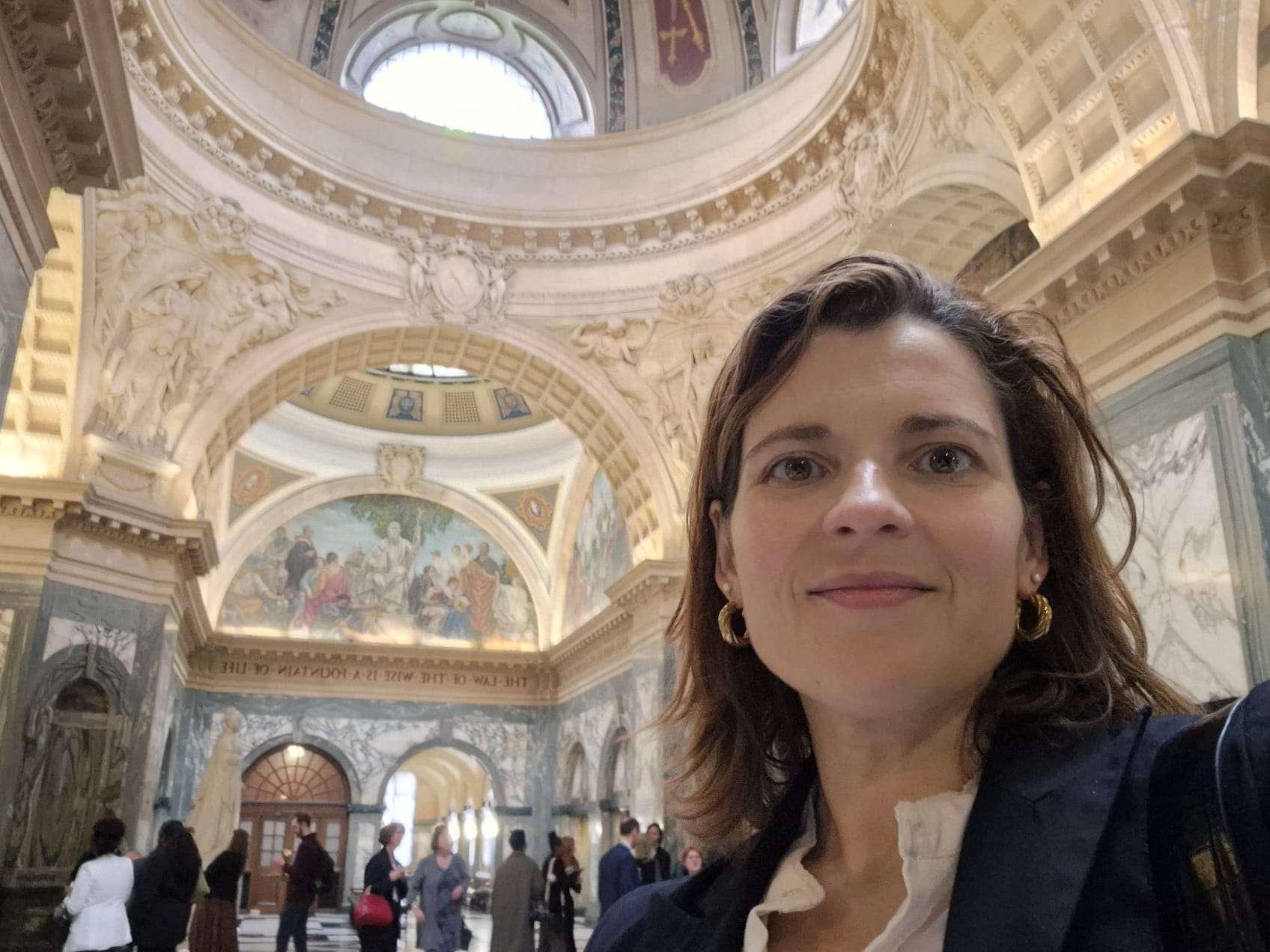
Last Wednesday, I stood in a wood-panelled room at the Old Bailey at half past four and swore an oath to King Charles III, his heirs and successors. By end of day I was back at my desk checking survey results.
This is, apparently, how you become a magistrate.
I’d been a school governor for a while already, had been mentoring young people on the side, and spent a fair amount of time as an Appropriate Adult in custody, but something about the formality of that oath — the Recorder in his wig, the velvet cushion, the slightly surreal quality of the whole thing, as my neighbour pointed out — made me want to write about why I do this. Why any of us do this. And what it says about how we think about time, work and what a life is actually for.
The meaning question isn’t going away
There’s a well-documented shift happening across generations, accelerating with millennials and apparently going further still with Gen Z: people want their work to mean something. Not just to pay well or offer security, but to genuinely matter. This isn’t naivety or entitlement. It’s a reasonable ask that most jobs, for most people, are unlikely to fully meet. It’s also a reasonable response from a generation that was told that what matters in life isn’t the job or the money, and then saw the adults around them organise their lives almost entirely around both, and arrive at retirement with very little idea of who they were outside of it.
Civic volunteering — magistracy, school governance, mentoring, trusteeships — is one answer to that. Not the only one, but a serious one. It puts you in contact with parts of society and systems of consequence that most professional lives quietly insulate you from. It gives you a role that isn’t about your career. And it asks something of you that has nothing to do with your billable hours.
A thought about the nobility (bear with me)
There’s a French expression — noblesse oblige — that roughly translates as: if you have privilege, you have responsibility. It’s often used cynically, and fairly so. But there’s a more interesting version of the idea worth sitting with.
When people have the means and the freedom to do whatever they want with their time, what do they actually do? The cynical answer — and the one behind most arguments against universal basic income — is that people are essentially lazy and will default to the least constructive version of themselves.
The historical evidence is more complicated than that. When you look at what people of means have tended to do with unstructured time, not all of them, and not without plenty of counterexamples, the answer is often: learn things, build things, engage with their communities, travel, create, take on civic roles. Not because they had to. Because it turned out to be more satisfying than doing nothing.
There’s a related idea I’ve always found quietly compelling. As a woman of the twenty-first century, all I ever really wanted was to be a renaissance man. Not out of gender envy, but in the oldest sense of the idea. The image of someone walking across Europe, writing and thinking and meeting people, having to travel the great places and encounter the great ideas to become a fully formed person. There was something deliberately expansive about that model of a life — the sense that facing other realities, reflecting seriously on questions of education or justice, staying genuinely curious about what was happening beyond your own immediate world, was not a leisure activity but a serious undertaking.
The point isn’t to romanticise a world built on exclusion. It’s that the model of the complete person — curious, ranging, engaged with more than one version of the world — is worth retrieving, and worth making available to more people than it historically was.
Which is why the AI question interests me more than it frightens me. Because the question of what people do when paid work stops being the organising principle of their days is no longer abstract. It’s arriving. The pessimists say people will collapse without the structure of work to hold them. The evidence suggests something more interesting.1
Civic roles. Learning. Creating. Contributing. The things that turn out, when you finally have time for them, to have been what you wanted to do all along.
A life lived in one lane was always a slightly impoverished version of what was possible. AI might, if we’re thoughtful about it, make a broader version of that life available to more people than just the privileged few.
This only works if your employer lets it
None of this is straightforward to arrange. When you apply to become a magistrate, one of the things they want to know is whether your employer is genuinely on board, not just tolerant, but supportive. And rightly so. Morning court sittings, school governor meetings at 8am, mentoring sessions in the middle of a Tuesday: these are not things you can do if your workplace treats flexibility as a reluctant concession.
I’m fortunate. A supportive workplace and a degree of schedule flexibility means I’ve been able to do more of this than I could before, and the difference it makes is real. But I’m aware that having that conversation — telling an employer you want to commit to something outside work that will occasionally ask something of your working hours — is not easy everywhere. In some places it’s actively discouraged. It bears saying, because it means the ability to do this is itself a kind of privilege, and one that organisations could extend more deliberately if they chose to.
What they get back, I’d argue, is worth it. Not as an act of corporate generosity, but as a straightforward exchange: a more grounded, more perspective-rich, more developed person walking back through the door.
The training you didn’t know you needed
There is a particular kind of responsibility that professional life doesn’t prepare you for very well, and tends to assume you’ve somehow acquired by the time it becomes relevant.
Governance is one version of it. Sitting on a school board teaches you something that no management role does: the discipline of asking the right questions rather than providing the answers. Managers can intervene when things go wrong. Governors cannot. Their role is to scrutinise, challenge, support and hold to account, while resisting the temptation to step into operational decisions. It sharpens your understanding of every board relationship, every investor dynamic, every advisory role you will ever be in. And it takes a while to actually learn. The instinct to manage rather than govern is, unsurprisingly, hard to override.
The magistracy asks something different again. The decisions are consequential in a way that focuses the mind considerably — you are, on occasion, sending people to prison. It asks you to weigh evidence carefully, sit with genuine uncertainty, and commit to a decision you can articulate clearly, on the record, to the person it affects.
And you do that as part of a bench of three. You don’t get to be the lone voice. You have to put your view, listen, negotiate, and either bring people with you or be brought. The qualities this requires — ethical clarity, composure, the ability to hold complexity without retreating to black and white — are ones that appear on every leadership framework ever written. The difference is that here, they are not assessed in a workshop. They are required, in real time, with real consequences.
I haven’t come across better training in my career. And I’ve only just started.
The rooms you wouldn’t otherwise be in
I want to be careful here. Being a magistrate is not the same as having grown up in the communities whose cases come before the court. Civic roles sit alongside lived experience; they don’t substitute for it. I’ll be learning far more than I contribute for a long time yet, and that feels right.
But that’s partly the point. These roles put you in rooms you wouldn’t otherwise be in, in front of problems you wouldn’t otherwise encounter, alongside people whose relationship to institutions, systems and daily life looks nothing like yours. Most professional environments, however diverse they aim to be, are still fundamentally self-selecting. Civic roles puncture that in a way that is hard to replicate and, once experienced, hard to do without.
And then there is the empathy question, which is harder to measure but probably the most important of all. You cannot sit with the range of human situations that civic roles bring you into contact with and remain entirely unchanged. Genuine exposure, genuine humility about the limits of what you understand, and what can be done about it, that combination is about as good a definition of empathy as I’ve found.
Wednesday afternoon, court room number 1
I didn’t expect to feel much, standing there making a solemn affirmation in a grand old room on a rainy Wednesday. The faintly Shakespearean formality of affirming allegiance to a king and his realm, though thoroughly enjoyable, felt a little dissociative. But what I felt, quietly and with some certainty, was excitement. The particular kind that comes not from knowing what lies ahead but from knowing that it will be considerable — complex, demanding, and genuinely worth showing up for.
That, I believe, far from being a distraction from a serious life, is part of what makes one.
- See, for example, the Finnish basic income experiment (Kela, 2020), the Stockton Economic Empowerment Demonstration (SEED, 2021), and the wider literature on cash-transfer programmes, which generally finds limited effects on labour participation alongside improvements in wellbeing, education, entrepreneurship and civic engagement. ↩︎