
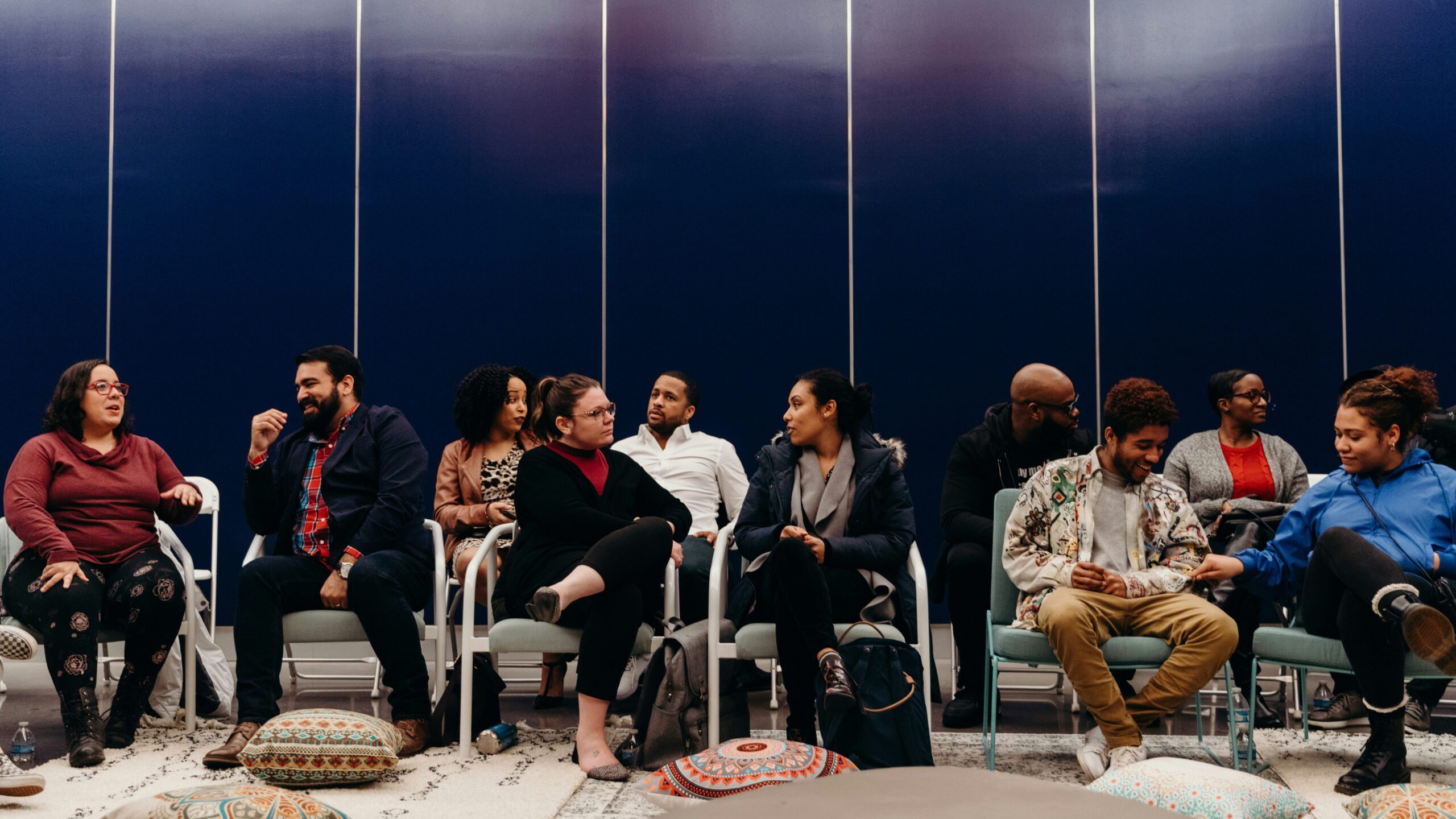
For all the talk about being people-centric, we have a strange habit of treating people like data points the moment it’s convenient: collect, extract, analyse, repeat. It’s not hard to see why that’s a problem. What’s harder to see is why it keeps happening, and the answer, more often than not, is that the people running the insight and the people running the engagement don’t really see themselves as doing the same job.
In most contexts, that gap is a missed opportunity. In complex, multi-stakeholder environments like infrastructure, transport and regulated platforms, where decisions are consequential, politics are real, and the wrong call is expensive, it’s more than that.
One of the core principles we build our programmes around is that insight and engagement should feed each other, continuously, throughout. Not sequentially. Not in handoff. Together.
It’s a structural choice that sounds modest. In practice, it changes quite a lot about what’s possible.
Evidence is only as good as its reception
Structured enquiry, the kind that builds a credible, honest picture of where things stand, is the foundation. But findings delivered cold to a room that wasn’t part of building them tend to get a particular kind of reception: polite acknowledgement, quiet challenge, or a shelf.
When the people who need to act on evidence have been part of producing it, even partially, something different happens. They recognise it. They’ve stress-tested it along the way. The conclusions feel earned rather than imposed, which means they’re far more likely to actually move something.
In complex, multi-stakeholder environments, that distinction matters enormously.
The gap no report can close
In most of the sectors we work in, the people who need to align around a product or service don’t naturally share a room. A local authority, a water company’s data team, a planning department and the contractors who will actually do the work on the ground all have a stake in the same outcome — but they operate in different worlds, speak different languages, and often have only a partial picture of what the others need or do.
Research can capture that variety. It can profile each group, surface their perspectives, and map where they diverge. What it can’t do is replace the moment when those people encounter each other’s thinking directly. Understanding and collaboration don’t come from reading about someone else’s constraints. They come from sitting with them.
The same is true for priorities. Research can map what each group cares about and why. But when those needs compete — and in complex ecosystems, they always do — the trade-offs can’t be resolved on their behalf. That has to be worked through by the people involved, with the evidence on the table and the stakes visible to everyone.
And then there’s alignment itself. The variety of actors in these environments, each with their own language, incentives and relationship to the product, is precisely what makes misalignment likely. Surfacing misalignment is not the same as resolving it. Getting everyone on the same page — about what the product is, what it isn’t, and where it’s going — is best done in the room, together. That’s not a limitation of research. It’s just what some problems require.
Engagement builds something that outlasts the project
There’s a less visible benefit to integrating engagement throughout, and it tends to be underestimated: the momentum it creates and the infrastructure it leaves behind.
Regular touchpoints build continuity. Sharing insight creates visibility and investment. People who are brought into the process, rather than consulted at the end of it, start to behave differently. They become advocates. They brief upwards. They surface problems early rather than at the review stage.
More practically, the steering group, the advisory panel, the set of informed relationships that emerge from a well-run programme don’t disappear when the project closes. They become the mechanism for continuous feedback, the thing that makes ongoing iteration possible rather than theoretical. When the product evolves and you need to go back and test assumptions, the infrastructure is already there. You don’t have to rebuild the context from scratch.
This is what user-centric development looks like when it actually works in practice, not a principle applied at the design stage, but a working structure sustained across the life of a product.
The constraint that makes it work
None of this is possible if engagement is treated as an open-ended ask. The stakeholders we work with in complex, regulated sectors are senior, they’re stretched, and their tolerance for process that doesn’t visibly produce something is, reasonably, low.
Effective engagement is light and purposeful. Every touchpoint needs a clear goal, and participants need to see what happened with what they contributed. The measure we use is simple: did that feel like an hour well spent? That’s the condition for people staying in the process, and for the feedback loops staying open.
Design the engagement around that constraint, and it becomes self-sustaining. Ignore it, and people disengage, and the work loses traction.
The real output
The proof is in what these programmes leave behind. Not just a report or a set of recommendations, but a working ecosystem: stakeholders who understand the evidence because they helped shape it, organisations that trust the process because they were part of it, and a feedback infrastructure that doesn’t have to be rebuilt from scratch every time the product evolves.
The pattern that gets you there tends to look similar each time — individual engagement first, so people can speak openly without the weight of the room, then collective sense-making, then co-creation grounded in something everyone has had a hand in shaping. But the sequence is less important than the principle behind it: that insight and engagement are most powerful when neither is waiting for the other to finish.
That’s what momentum looks like in complex environments. Not something you generate at the end. Something you build throughout.
Interested in how this may work for you?
Let’s talk! charlotte.paris@madewithinsight.com